Theme images by kelvinjay. Powered by Blogger.

Slider

ESAT

Ethiopian News

Movies

Drama

Sport

Opinion

History

‘Ain’t nobody been locked up. And they ain’t trying to solve nothing.’

‘Ain’t nobody been locked up. And they ain’t trying to solve nothing.’

Washington Post Chicago —Deangelo Norwood had been in the hospital for three days when the detectives appeared, asking questions about the man who had shot him in the stomach, chest and wrist.

“Is this the guy?” they asked, holding up a grainy photo. Could be, Norwood said, but he didn’t know the guy and, to be honest, he hadn’t gotten a good look.

Nearly a month later, no one has been arrested for the July 30 shooting outside a Chicago liquor store that severely injured Norwood, 30, and killed his brother, Omar, 35.


“That’s the norm in this city. We live amongst a lot of killers,” Norwood said, adding that the detectives have stopped calling. “Ain’t nobody been locked up. And they ain’t trying to solve nothing.”

The Norwood brothers have joined the grim ledger of Chicago violence, part of a wave of summer shootings that has propelled the city, once again, to the forefront of the national debate over guns and violence. As of Tuesday, 365 had been killed in Chicago this year, more than any other U.S. city.

Yet the growing death toll obscures a far larger group of victims — more than 1,600 people who, like Norwood, have been shot this year and survived. While homicides routinely go unsolved here, the perpetrators of nonfatal shootings are even less likely to be brought to justice.

Since 2010, Chicago police have made arrests in only about 27 percent of homicides, according to a Washington Post analysis of homicide data in more than 50 major U.S. cities — the lowest rate of any city The Post examined.

Deangelo Norwood was severely injured after being shot July 30 outside a Chicago liquor store. (Whitten Sabbatini/For The Washington Post)
For nonfatal shootings, the arrest rate plummets into the single digits, according to data maintained by the University of Chicago Crime Lab. The latest report shows Chicago police made an arrest in 10 percent of nonfatal shootings in 2014, 7 percent in 2015 and just 5 percent — 1 in 20 — in 2016.

While the numbers in Chicago are particularly abysmal, the pattern appears to hold in other cities. Because no comprehensive national data is available on arrest rates for nonfatal shootings, The Post requested that information from 50 major U.S. cities. Only six provided it and only for select years.

In those places, The Post found that nonfatal shootings were less than half as likely as homicides to result in arrests. In Charlotte, for example, police have made an arrest in 71 percent of homicides but just 30 percent of nonfatal shootings since 2013. 


In Miami, police made an arrest in 1 in 3 homicides but just 1 in 5 nonfatal shootings between 2014 and 2016. And in Omaha, police made arrests in 67 percent of homicides but just 18 percent of nonfatal shootings in 2016 and 2017.

Chicago police officials say they have significantly improved their ability to solve both homicides and nonfatal shootings by strengthening their relationships with the community. Both homicides and nonfatal shootings are down compared with this time last year. And, police noted, the department had made arrests in 44 percent of homicides committed through mid-August, up from 33 percent during the same period last year.

“We have been making considerable investments,” said police spokesman Anthony Guglielmi, noting that the department plans to hire 300 additional homicide detectives by the end of this year, bringing the total to more than 1,200.

But in Chicago and across the nation, police say the same factors that make it difficult to solve homicides make it difficult to solve nonfatal shootings. Minority communities, which tend to produce the most victims, also tend to distrust police. Witnesses are likely to fear retaliation for “snitching.” And victims may be unwilling to cooperate because telling the truth about the shooting could implicate them in a crime.

Police investigate an Aug. 18 shooting at a Subway in Chicago. (Tyler LaRiviere/Chicago Sun-Times/Associated Press)
“The other night, we had three people shot. They all take themselves to the hospital, they don’t wait for the cops or the ambulance. Then . . . they tell us to go ‘F’ ourselves,” said William Evans, the former police commissioner in Boston, where Boston Magazine last year found that police made arrests in just 4 percent of nonfatalshootings between January 2014 and September 2016.

While police say they cannot solve crimes without the cooperation of the public, leaders in the black community say the failure to solve crimes is fueling the distrust — along with a deadly cycle of impunity and retaliation that begets more violence.

“These communities have degenerated into a lawless vigilante justice, where people have to get justice on their own terms because the police won’t get it for them,” said the Rev. Marshall Hatch Sr., pastor of New Mount Pilgrim Missionary Baptist Church on Chicago’s troubled West Side.

“People feel like they’ve got to take the law into their own hands.”

Cook County State’s Attorney Kim Foxx agrees with that assessment. Foxx is the first African American woman elected to head the prosecutor’s office that handles Chicago crime, one of the biggest and busiest in the nation.

The lack of arrests, she said, leaves thousands of families waiting for a justice that never comes.

“It’s heartbreaking. Each day that passes, the likelihood of us being able to put together a winning case diminishes,” she said.

While witnesses might feel an obligation to cooperate with police after someone has been killed, Foxx said, nonfatal shootings can leave people feeling that it’s “more pragmatic to deal with this in the street justice system.”

That was how Deshon Hannah saw things four years ago when he was hit with 30 buckshot pellets from a shotgun blast fired by a rival gang member in Chicago’s Back of the Yards neighborhood.

“I didn’t want him to go to jail, to be honest,” Hannah, 20, said of his shooter. “I wanted my retaliation. I wanted to shoot the person who shot me.”

Hannah, who has since become an anti-violence activist, said he had no interest in cooperating with Chicago police, who he said routinely harassed and mistreated his family, friends and neighbors. The police eventually arrested someone without his help.

Scores settled in the street often produce “collateral damage,” further raising the victim count as innocent people are caught in the crossfire, said Eric Russell, a Chicago police accountability activist.

“They’re shooting into crowds; some of them are high off of drugs and narcotics. They’re reckless,” Russell said this month after 72 people were shot — 12 fatally — in a single Chicago weekend.

“If there is a silver lining, thank God these shooters can’t aim. These kids are just terrible shots.”

Whether a shooting is fatal or nonfatal often comes down to luck: Where the bullet strikes. How quickly someone dials 9-1-1. When the ambulance arrives. The distance to the nearest trauma center.

Still, policing experts acknowledge that the public — and, in some cases, the police — tends to focus almost exclusively on fatal shootings. Many cities don’t even bother to track how many nonfatal shootings their police handle, much less how many result in arrests.

“The homicides get all of the attention and all of the resources,” said Natalie Kroovand Hipple, an Indiana University criminal justice professor who studies gun violence.

Tio Hardiman, a longtime community activist in Chicago, tries to stop violence “on the front end,” before it happens. But in a city with thousands of shootings and hundreds of homicides each year, Hardiman spends most of his time with people who are already victims.

“If I’m being straight up, there is a lot of hopelessness,” he said. “And no faith in the police department.”

As Hardiman spoke, he stood sweating in a baggy gray suit in a field on the Far South Side where the bodies of two boys had been discovered four days earlier: Darnelle Flowers, 17, and Raysuan Turner, 16.

Through a steady stream of anonymous tips, Turner’s family had pieced together their best guess at what happened: They believe the boys were lured to the neighborhood by two girls, one of whom was angry over a schoolyard dispute. After meeting the girls and two unidentified males in a park, the boys were led to the overgrown field, shot and left for dead.

But making the leap to an arrest has proved frustrating. The tipsters don’t want to be identified. Two witnesses tracked down by a local activist disappeared when it came time to speak with prosecutors. Two people who had been held as persons of interest have been released.
Police investigate an Aug. 19 shooting in Chicago. (Tyler LaRiviere/Associated Press)
“I just hope that somebody has the balls to come forward,” said Turner’s mother, Rayniecia Morris, sliding on sunglasses to hide the tears pooling at the corners of her eyes. “There are people out there who know what happened to my son, and they need to come forward.”

On the day they were shot, the Norwood brothers had stopped to buy water and a pack of gum from Ziad Certified Liquor, a market in Bronzeville where a hand-painted mural of a black trumpeter gazes down at customers from above the Budweiser cooler.

Born to a drug-addicted mother and raised — along with six siblings — by a devoted, diligent grandmother on Chicago’s rough South Side, both were dream chasers who longed to get out. Instead, they got caught up in the chaos. Both went to prison: Deangleo for a stickup and Omar for the unlawful use of a weapon.

But things had been going well since they got out. Deangelo had finished his GED and found a job with Divvy, the city’s bike-share program. Omar worked in food service and began taking classes to become an electrician. The brothers talked about pooling their money and opening a juice bar in Chicago’s booming downtown.

Then Omar started dating a woman with an ex-boyfriend who also had just gotten out of prison. As the woman waffled between them, Omar and the other man began taunting each other on social media, Norwood said.

The shooting occurred when three of the man’s friends spotted the Norwood brothers in the candy aisle of the liquor store. A heated argument led to a fistfight on the sidewalk outside. The Norwoods were winning, Norwood said — until one of the men pulled out a gun.

Omar died instantly, shot in the back of the head. Norwood crumpled to the ground next to his brother, bleeding from a hole in his chest.

During 17 hours of surgery, doctors removed his spleen and part of his liver, leaving his abdomen a patchwork of staples, stitches and scars. He spent weeks in the hospital, then decamped to a small apartment in Indiana to heal. These days, just pulling on socks is a painful, complicated task.

Aside from the physical pain, the emotional trauma has left him by turns hopeful and despondent. One minute, he’s making plans to go back to work, save $15,000 and open that juice bar. The next, he’s saying he feels lost without his big brother.

“It’s like I’m half dead and half alive,” he says softly. “I’ll never be the same again.”

Meanwhile, the shooting plays on a loop in his head. He sees the gun, the muzzle flash, the blood. His brother’s pained expression as he falls.

Norwood has relived that moment hundreds of times. But he still can’t come up with anything that would help police find the guy who shot him.

wesley.lowery@washpost.com

Family spokesman says former first lady Barbara Bush is in "failing health"


HOUSTON — Family spokesman says former first lady Barbara Bush is in "failing health" and won't seek additional medical treatment.

Source - Associated Press

Trump slams Comey as 'weak and untruthful slime ball'


President Donald Trump slammed James Comey on Friday as a "weak and untruthful slime ball" and a "proven LEAKER & LIAR," the day after explosive excerpts from the former FBI director's tell-all book surfaced in media reports.

"James Comey is a proven LEAKER & LIAR. Virtually everyone in Washington thought he should be fired for the terrible job he did — until he was, in fact, fired. He leaked CLASSIFIED information, for which he should be prosecuted.


He lied to Congress under OATH," Trump tweeted. "He is a weak and untruthful slime ball who was, as time has proven, a terrible Director of the FBI. His handling of the Crooked Hillary Clinton case, and the events surrounding it, will go down as one of the worst 'botch jobs' of history. It was my great honor to fire James Comey!"

Comey's book "A Higher Loyalty," a copy of which CNN obtained, details his conversations with the President, compares Trump to a mob boss, and slams the "forest fire that is the Trump presidency."

Comey testified in June that he gave some of his memos of conversations he had with Trump to a Columbia University professor and that he had written the memos specifically to avoid including classified information.
White House press secretary Sarah Sanders also attacked Comey's credibility Friday.

"One of the few areas of true bipartisan consensus in Washington is Comey has no credibility," Sanders wrote on Twitter Friday morning.

Her post also included the link to a GOP video entitled "Comey Not Credible, Just Ask Democrats."
White House counselor Kellyanne Conway on Friday also criticized the former FBI director.

"We find Mr. Comey has a revisionist view of history and seems like a disgruntled ex-employee," Conway told reporters outside the White House.

Trump's allies have prepared an extensive campaign to fight back against Comey's publicity tour, trying to undermine his credibility by reviving the blistering Democratic criticism of him before he was fired nearly a year ago.

The battle plan against Comey, obtained by CNN Thursday, calls for branding him "Lyin' Comey" through a website, digital advertising and talking points to be sent to Republicans before his memoir is released next week. The White House signed off on the plan, which is being overseen by the Republican National Committee.

CNN's Abby Phillip, Noah Gray and Jeff Zeleny contributed to this report.


Source - CNN

Chemical watchdog confirms novichok poisoned Sergei Skripal

Independent chemical weapons scientists have confirmed that "high purity" novichok was used in the attempted murder of former Russian spy Sergei Skripal and his daughter Yulia.
Tests carried out by experts from the Organisation for the Prohibition of Chemical Weapons (OPCW) showed the nerve agent was found in environmental samples collected in Salisbury.

Blood tests also revealed that the chemical was found in blood samples taken from the Skripals and Detective Sergeant Nick Bailey, the police officer who first attended the scene.
The report from the OPCW says the chemical was "high purity" with a complete absence of contaminants.
Foreign secretary Boris Johnson called the results "conclusive".
"There can be no doubt what was used and there remains no alternative explanation about who was responsible - only Russia has the means, motive and record," he said.

The tests were carried out by four independent laboratories affiliated with OPCW and samples were transported under a "full chain of custody", the report said.
It did not name novichok directly but said: "The results of the analysis by the OPCW designated laboratories of environmental and biomedical samples collected by the OPCW team confirms the findings of the United Kingdom relating to the identity of the toxic chemical that was used in Salisbury and severely injured three people."

Tests by military experts at the Porton Down laboratories in Wiltshire found that novichok, one of a group of deadly chemical compounds developed by the Soviet government in the 1970s and 1980s, was responsible for the poisoning.

Russia has strongly denied involvement in the Skripal's poisoning and challenged the UK assessment that novichok was to blame.

The OPCW was tasked with identifying the chemical, not with attributing its origin or ascertaining blame for the poisoning.

Responding to the report, Britain called a session of the OPCW to discuss next steps. "We will now work tirelessly with our partners to help stamp out the grotesque use of weapons of this kind," Boris Johnson said in his statement.

"The Kremlin must give answers. We must, as a world community, stand up for the rules based order which keeps us all safe. The use of weapons of this kind can never be justified, and must be ended."

More than a month after the pair were found unconscious on a bench in Salisbury, Yulia Skripal has been discharged from hospital and her father Sergei is no longer in a critical condition.
Source - Sky News

Donald Trump says US attack on Syria 'could be very soon or not so soon at all'

Amid speculation over an impending US missile strike on Syrian military assets, Donald Trump has tweeted that an American attack could come "very soon or not so soon at all".
The US president said he “never said when an attack on Syria would take place.”
Mr Trump has said he will follow Israel in conducting an attack on the Syrian regime in response to a suspected chemical weapons attack on civilians in Douma, eastern Ghouta.
He tweeted: “Never said when an attack on Syria would take place. Could be very soon or not so soon at all! In any event, the United States, under my Administration, has done a great job of ridding the region of Isis. Where is our ‘Thank you America?’”
Mr Trump previously warned Russia to “get ready,” saying missiles “will be coming.”
After Moscow threatened to shoot down any missiles fired at Syria, Mr Trump tweeted: “Russia vows to shoot down any and all missiles fired at Syria. Get ready Russia, because they will be coming, nice and new and “smart!” You shouldn’t be partners with a Gas Killing Animal who kills his people and enjoys it!”
The US defence secretary, James Mattis, said the US was assessing intelligence about the suspected gas attack.
Asked if he had seen enough evidence to blame the Syrian president, Bashar al-Assad, Mr Mattis said: “We’re still working on this.”
Video - Syria: "All options on table" says White House in response to Douma attack (France24)


Both Syria and Russia have said reports of the attack were fabricated by rebels and rescue workers in Douma.
They have accused the US of seeking to use it as a pretext to attack the regime.
Source - The Independent

Former South Sudan military chief launches rebel group - By AGGREY MUTAMBO

Move further splinters warring parties as the general confirms long-held rumours.

South Sudan’s ex-military chief Paul Malong has formed a new rebel movement, further splintering the warring parties to the conflict but confirming long-held rumours.

On Sunday, Malong announced in a statement that he was forming the South Sudan United Front to ostensibly bring democracy to South Sudan by ensuring citizen rights to life.

Once an ally of President Salva Kiir, Malong accused the Juba government of looting and maiming the citizens.

“Salva Kiir...has concentrated all his efforts, with the help of a small clique around him, to quite literally loot the coffers of our great country to total bankruptcy,” he said.

“Our movement is a just and urgent call to our compatriots and a struggle to first arrest the carnage that has befell our country, and secondly to steer us towards democracy and development, which are the cornerstones of nationhood.

Malong, a onetime governor of Northern Bahar el Ghazal state was appointed South Sudan Chief of General Staff in 2014. Some observers say he became so powerful that he had to give an okay for the President to sign on the peace agreement reached in August 2015 in Addis Aba a but which Mr Kiir signed weeks later.

But the two fell out following a US push to sanction those perceived to be violating the peace agreement. Mr Malong and other South Sudan military and rebel chiefs initially survived a motion at the UN Security Council seeking to impose an asset freeze and embargo on the violators. But the motion was defeated.

But Malong, believed to be one of the wealthiest South Sudanese, fell out with Kiir in May last year and was replaced. Fearing he could form a mutiny, authorities in South Sudan restricted his movement, including preventing him from coming to Nairobi to collect the body of his daughter who was among students who had perished at the Moi Girls fire in Nairobi.

All along though, Malong had denied any bid to enter rebelions, insisting he wanted to live a private life.

On Sunday, he accused Kiir government of refusing to implement the peace agreement signed between Salva Kiir and Riek Machar.

“Salva Kiir’s regime has perfected the art of obstructionism and deceit. It is therefore impossible to entrust another agreement in the hands of the very same people who obstructed the implementation.”

The South Sudan United Front, he said, will now join the opposition alliance SSOA, which includes ten other movements but not Riek Machar’s Sudan Peoples Liberation Movement in Opposition (SPLM/IO).

The entry of Malong means the parties to the conflict have ballooned, further raising possibility of delayed resolution to the conflict that began in December 2013. While the former military chief says he will sign on the cessation of hostilities, Malong says he will not accept Salva Kiir to be involved in implementing a new pact, even as he demands that all parties be given equal opportunity to table issues at the negotiation table. Regional bloc IGAD is set to convene another meeting in Addis Ababa on April 26.

South Sudan fell into the current conflict after soldiers allied to Dr Machar, then a vice president, mutinied in December 2013, leading to a full-blown conflict.

Machar is currently under House arrest in Pretoria.

Matatu, Which Threw Passenger Out And Crashed Him To Death, Has Been Set Loose By Police

Nairobi city matatu with registration number KCC 420M is said to have killed one of its passengers in the most horrific way possible.

Dennis Masila was thrown out of the high speed moving matatu, then the matatu crashed him and run away leaving him to death. Late Masila was heading to Highrise before he met his death

The matatu which was impounded by Kilimani Police Station officers is said to have been set loose again before the case was even set to the next stage.

The deceased siblings who visited the police station are appealing for help since the police are not following up to the matter as they thought before

North Korea confirms to White House that it is willing to talk about denuclearization, administration officials say

North Korea has confirmed directly to the Trump administration that it is willing to negotiate with the United States over potential denuclearization, administration officials said Sunday.
The confirmation offers the administration greater assurances that North Korean dictator Kim Jong Un is committed to a potential meeting with President Trump by the end of next month.
“The U.S. has confirmed that Kim Jong Un is willing to discuss the denuclearization of the Korean Peninsula,” an administration official said.
South Korean emissaries, in a visit to the White House last month, had presented Kim’s invitation to meet with Trump, who quickly agreed.
But Pyongyang has been silent publicly since then about a summit, even as Kim visited Beijing earlier this month in his first visit outside North Korea since assuming control of the country after his father, Kim Jong Il, died in 2011. The Wall Street Journal was the first to report that the North has confirmed the offer to the United States.
Trump said last month that he was willing to have the historic meeting with Kim and instructed his aides to arrange it before the end of May. Japanese Prime Minister Shinzo Abe is scheduled to make a two-day visit with Trump at Mar-a-Lago, the president’s resort near Palm Beach, Fla., to coordinate strategy between the allies. South Korean President Moon Jae-in plans to meet with Kim at the end of April in the demilitarized zone between the North and South.
White House officials have not said where the Trump-Kim summit will be held. The agenda of the meeting is not yet known, and North Korea has not been clear about what steps it is willing to take to move toward denuclearization. During previous negotiations under different U.S. administrations, the North has agreed to freeze its nuclear weapons program in exchange for the lifting of international economic sanctions, only to violate the agreement by testing more weapons.
John Hudson contributed to this report.
Source - Washington Post

Mugabe resigns for 'smooth transfer of power'

Update:
Zimbabwe's President Robert Mugabe says he is resigning immediately and voluntarily in order to have a "smooth transfer of power" after 37 years in charge. The letter was read out in a cheering, dancing Parliament, which had been pursuing impeachment of the 93-year-old Mugabe, the world's oldest head of state.
Zimbabwean President Robert Mugabe delivers his speech during a live broadcast at State House in Harare, Sunday, Nov, 19. Zimbabwe's President Robert Mugabe has baffled the country by ending his address on national television without announcing his resignation.
The resignation comes at the end of a week of extraordinary events that began with the military moving in last week, angered by Mugabe's firing of his longtime deputy and the positioning of the unpopular first lady to succeed him.

Impeachment allegations against Mugabe included that he "allowed his wife to usurp constitutional power" and that he is "of advanced age" and too incapacitated to rule.

Mugabe also was accused of allowing unpopular first lady Grace Mugabe to threaten to kill the recently fired Vice President Emmerson Mnangagwa and other officials.

Earlier
HARARE, Zimbabwe (AP) — Zimbabwe's Parliament launched impeachment proceedings against President Robert Mugabe on Tuesday, with both ruling party and opposition support, while the recently fired vice president said the world's oldest head of state should acknowledge the nation's "insatiable desire" for a leadership change and resign immediately.

The statement by Emmerson Mnangagwa added to immense pressure on the 93-year-old Mugabe to quit after nearly four decades in power, during which he evolved from a champion of the fight against white minority rule into a figure blamed for a collapsing economy, government dysfunction and human rights violations.

The ruling ZANU-PF party began impeachment proceedings against Mugabe after its Central Committee voted to oust the president as party leader and select Mnangagwa as his replacement, a move that eventually could allow the former vice president to become head of state. Mnangagwa served for decades as Mugabe's enforcer, with a reputation for being astute and ruthless, more feared than popular.

Crowds rallied outside Parliament, dancing and singing. Some people placed photos of Mugabe in the street so that cars would run over them. Opposition leader Morgan Tsvangirai of the MDC party said the culture of the ruling party "must end" and everyone must put their heads together and work toward free and fair elections.

The impeachment motion was introduced by the ruling party and seconded by the opposition MDC.

"The people of Zimbabwe have spoken with one voice and it is my appeal to President Mugabe that he should take heed of this clarion call and resign forthwith so that the country can move forward and preserve his legacy," Mnangagwa said in his statement, after more than a week of silence.

Mnangagwa, who fled the country and has not appeared in public during the past week's political turmoil, said Mugabe had invited him to return to Zimbabwe "for a discussion" on recent events. However, he said he will not return for now, alleging that there had been plans to kill him at the time of his firing.

 I will be returning as soon as the right conditions for security and stability prevail," said Mnangagwa, who has a loyal support base in the military. "Never should the nation be held at ransom by one person ever again, whose desire is to die in office at whatever cost to the nation.

Zimbabwe's polarizing first lady, Grace Mugabe, had been positioning herself to succeed her husband, leading a party faction that engineered Mnangagwa's ouster. The prospect of a dynastic succession alarmed the military, which confined Mugabe to his home last week and targeted what it called "criminals" around him who allegedly were looting state resources — a reference to associates of the first lady.
Mnangagwa was targeted by U.S. sanctions in the early 2000s for undermining democratic development in Zimbabwe, according to the Atlantic Council, a U.S.-based policy institute. However, J. Peter Pham, an Africa expert at the council, noted that some Zimbabwean opposition figures have appeared willing to have dialogue with Mnangagwa in order to move the country forward and that the international community should consider doing the same.

 We're not saying whitewash the past, but it is in the interests of everyone that Zimbabwe is engaged at this critical time, Pham said in a statement.

Regional leaders continued efforts to find a solution to the political turmoil, with South Africa's state-run broadcaster reporting that the presidents of South Africa and Angola would travel to Zimbabwe on Wednesday to meet with "stakeholders" in the political crisis, including Mugabe and the military.

Impeachment proceedings began days after huge crowds surged through the capital, Harare, to demand that Mugabe quit. The ruling party had instructed government ministers to boycott a Cabinet meeting that Mugabe called for Tuesday morning at State House, the president's official residence, and instead attend a meeting at party headquarters to work on the impeachment.

The ruling party says the charges for impeachment include that Mugabe "allowed his wife to usurp constitutional power" and that he is "of advanced age" and no longer has the physical capacity to run the government.

It was not clear how long the impeachment process could take. The ruling party has said Mugabe could be voted out as early as Wednesday but some analysts believe the impeachment process could take weeks and would, if conducted properly, allow Mugabe to make a case in his defense.

Mnangagwa said he was aware of the move to impeach Mugabe. Though unpopular in some parts of Zimbabwe, the former vice president called for unity and appeared to embrace the prospect of taking over power.

 I will not stand in the way of the people and my party, he said.
By CHRISTOPHER TORCHIA and FARAI MUTSAKA, Associated Press

W.H.O. Removes Robert Mugabe as ‘Good-Will Ambassador’

By Yonette Joseph (Washington post) - After days of scathing criticism around the globe for naming Zimbabwe’s leader, Robert Mugabe, a “good-will ambassador” for health, the leader of the World Health Organization said on Sunday that he had rescinded the title.


In a statement, the W.H.O.’s director general, Tedros Adhanom Ghebreyesus, said he had “reflected” on the appointment.

“I have listened carefully to all who have expressed their concerns, and heard the different issues that they have raised,” he said. “I have also consulted with the government of Zimbabwe and we have concluded that this decision is in the best interests of the World Health Organization.”

On Wednesday, at a global conference in Uruguay on noncommunicable diseases, Dr. Tedros, an Ethiopian and the first African to lead the United Nations’ health agency, said he was “honored” to be joined by Mr. Mugabe, 93, and appoint him an ambassador.

Dr. Tedros said the leader could use the role “to influence his peers in his region” when it came to fighting noncommunicable diseases — such as heart attacks, strokes and asthma — in Africa.

He also praised Zimbabwe as “a country that places universal health coverage and health promotion at the center of its policies to provide health care to all.”

The reaction was swift and unforgiving.

Prime Minister Justin Trudeau of Canada joined a chorus of world leaders, the State Department, medical professionals and social media users who expressed outrage or puzzlement at the appointment.

Appearing in Edmonton on Saturday, Mr. Trudeau told reporters that he thought the choice of Mr. Mugabe was “a bad April Fool’s joke,” according to the local news media.

Twenty-eight health organizations, including the NCD Alliance — which works with the W.H.O. and other global groups to battle noncommunicable diseases — released a statement expressing “shock” at the appointment.

Obert Gutu, a spokesman for Zimbabwe’s main opposition party, Movement for Democratic Change, said, “It is an insult.”

He added: “Mugabe trashed our health delivery system. He and his family go outside of the country for treatment in Singapore after he allowed our public hospitals to collapse.”

Under Mr. Mugabe’s authoritarian rule, critics say, the country’s health care system, like many of its public services, has suffered badly, with hospitals frequently lacking essential supplies and nurses and doctors regularly left without pay.

Mr. Mugabe and Zimbabwe have also been slapped with international sanctions over human rights abuses.

Hillel Neuer, the executive director of UN Watch, a human rights group, had condemned the choice. He called on Dr. Tedros to reconsider, writing on Twitter: “@DrTedros I urge you to cancel your appointment of Mugabe as W.H.O. ‘good-will ambassador’ — he ruined Zimbabwe’s health.”

Neither the president nor his government has reacted publicly to the controversy.

In a tweet on Saturday, Dr. Tedros wrote: “I’m listening. I hear your concerns. Rethinking the approach in light of WHO values.”

A spokesman for the W.H.O., Christian Lindmeier, had said that the agency’s director general was seeking broad support for its work.

“Tedros has frequently talked of his determination to build a global movement to promote high-level political leadership for health,” he said.

In his statement on Sunday, Dr. Tedros said, “I remain firmly committed to working with all countries and their leaders to ensure that every one has access to the health care they need.”

Hydro-economics: Egypt, Ethiopia and the Nile


A look at the ongoing dispute over the Grand Ethiopian Renaissance Dam and its impact on the world's longest river.


Water ministers from Egypt, Sudan and Ethiopia have gathered last week to discuss how Africa's largest hydroelectric dam will affect water distribution and access to the Nile.

The Grand Ethiopian Renaissance Dam (GERD) is 60 percent complete and has yet to go into operation. The $4.8bn megaproject near the Sudanese border was launched in April 2011.

Water rights and the utilisation of water from the Nile for power generation still remain highly contentious issues. And there are concerns about GERD's impact on the river and downstream nations.

Nearly a quarter of a billion people rely on the Nile's waters.

Its basin covers eleven countries: Tanzania and Uganda, Rwanda, Burundi, the Democratic Republic of Congo, Kenya, Ethiopia, Eritrea, South Sudan, Sudan and Egypt.

Egypt and Sudan claim exclusive rights to its use and object to anything that might affect the river. This is based on colonial-era treaties of 1929 and 1959 that gave Egypt and Sudan the lion's share of the Nile's water. Egypt was also given veto power over dams in upstream countries.

Most of Egypt's Nile water originates in Ethiopia from the Blue Nile, and the nation hopes for the Renaissance dam to help boost its economy. In a major breakthrough, the three countries signed a cooperation deal on the project in 2015. But Egypt still fears that the dam will cut into its water supply.

"The building of a great dam is bound to have impacts, both locally and throughout the river system, it's all one joined-up system. However, the way that it's done, the way that it's built, the way that it's filled, and the way that it's managed can massively reduce those impacts," Colin Thorne, professor and chair of Physical Geography at the UK-based Nottingham University, tells Al Jazeera.

He believes that "if the addition of another dam to a river is done in a coordinated fashion, with the existing dams and water resource developments, then actually the addition of a dam can be beneficial. So it's all in the way that you do it and in the way that you operate the dam afterwards."

Asked about Egypt's concerns regarding the dam and its impact, Thorne says, "I think any country in Egypt's position would have concerns about developments of a major water resource upstream.... they don't have control over what happens upstream of them, so they are justified to be nervous, but they must enter into full dialogue with Sudan, with Ethiopia, indeed with the other countries in the Nile basin. That's the only way that the Nile can be managed in a coordinated fashion to the benefit of all the nations."

According to him, there's always a possibility of a regional resource conflict, but "the Nil is a fantastic water resource. It's been exploited for not just centuries but millennia, and that's going to go on in the future at a time of increased water stress, because of climate change. And if the nations and the engineers and the technical experts work together, then fears, although understandable, will be unnecessary."

Source - Aljazeera

Take a look at the house where President Uhuru was conceived in 1961

By 

  • The house is located in a cool and serene environment in the dust town of Maralal
  • Mzee Jomo Kenyatta lived here for one year after his transfer from Lodwar
  • The house was gazetted as a national monument in1977
Kenyatta House, Maralal, Samburu county [Photo: Jenipher Wachie]
It is a building where the first president of Kenya Jomo Kenyatta stayed during his last days of detention in the year 1961.
This is also the same place where President Uhuru Kenyatta was conceived.
Mzee Jomo Kenyatta lived here for one year after his transfer from Lodwar where he and five other politicians were detained in relation to the Mau Mau uprising.
 His family - Mama Ngina Kenyatta and daughters Christine and Jane Njeri - joined him.
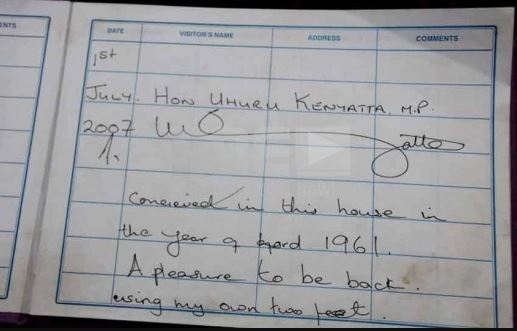
In the house is a visitors’ book signed by President Uhuru Kenyatta on July 1, 2007 after visiting the house when he was a Member of Parliament for Gatundu and the official Opposition leader.
In the book, he acknowledged that he was conceived in the house and wrote: “I was conceived in this house in 1961. A pleasure to be back using my own two feet.”

This building played a crucial role in the independence of this country as it became the centre of reconciliation for the founding father of the nation who had been mistreated and mishandled by the colonialists.
Welcome to Kenyatta House in Maralal. The three-bedroom bungalow in Samburu County was built in 1959 for senior colonial administrators who worked in Samburu.
The house, which is a historical monument, is located in a cool and serene environment in the dust town of Maralal.
Surrounded by trees, the house has a kitchen, a store, bedrooms (guest, master and children bedrooms), a washroom and a living room.
 Original look
The curator of the house, John Rigano, told Home and Away that everything in the house is the way it was back then, but the walls were painted in their original colours.
“Nothing has been replaced in the house but the walls were only painted in their original colours,” he says.

Though there is no electricity in the house, Rigano says the hooks on the walls of the house, suggest that lantern lamps were used to light the house.
In the kitchen is an oven, which used firewood and also heated water through a pipe connecting the rooms to the bathroom, which has a bathtub.
The living room is spacious with a dining table with six chairs on one end, and another small table with four chairs on the other.
Beside the small table is a fireplace. In one corner of the living room is a telephone placed there by the colonialists for communication between Mzee Kenyatta and the British government.

All the three bedrooms (guest, master and children’s) are fitted with wardrobes and spring metallic beds, with mattresses made of cloth and stuffed with sisal fibre.
Rigano says the guest bedroom, which is smaller than the rest, was meant for prominent personalities who visited Kenyatta during his stay in Maralal.
“Former President Mzee Daniel Arap Moi visited Mzee Kenyatta while in Maralal and he slept on the bed,” he says.
Other leaders who visited him in Maralal were Oginga Odinga, Ronald Ngala, James Gichuru and John Keen.
The master bedroom where Kenyatta slept is bigger and has a working desk facing the window.
The curator says Kenyatta sat here while he was finalising his book, Facing Mount Kenya. Currently, one cannot get a clear view of Mt Kenya because the line of sight is obstructed by trees.
“The trees in the compound were planted later but initially the vicinity was clear and bare with no trees and one could get a clear view of Mt Kenya,” he adds.
Also in the room is a dressing mirror and a charcoal iron box. Here, Rigano says, is where President Uhuru Kenyatta was conceived.

Next to the house is a smaller building where Mzee Kenyatta’s two security guards lived. One of the guards, Rigano says, was Kenya’s first athletics gold medal winner, Kipchoge Keino.
Interestingly, most locals don’t think the house is special because they don’t know the history behind it.
“Some of the locals who are educated think that Mzee Kenyatta was imprisoned here while those who have not gone to school take it like just any other house. They don’t even bother to visit it,” Rigano explains.
He adds that the community is not aware that the person who resided in the house was doing so for the sake of Kenya’s independence.
Francis Lengapache, 59 and a resident of Maralal, says that he visited the place when he was a young boy but he never knew the history behind the house.
“I am not aware of the history behind the house but when I was a young boy, I used to graze our livestock in the compound,” Lengapache says.
The house, which is under the National Museums of Kenya, was gazetted as a national monument on January 14, 1977.